
In Jean-Jacques Rousseau’s essay Discourse on the Origin and Basis of Inequality Among Men (1755), he attempts to explain how social inequality came to be. Human beings, he argues, at one time existed in a state of nature not dissimilar to the animals. We were unafraid of death, because of a lack of reason, and moved throughout the world with a sense of self-preservation. Rousseau’s Natural Man, however, would eventually be lifted out of a state of nature. In Friedrich Schelling’s System of Transcendental Idealism, he also attempts to conceive of the origin of consciousness, and sees human beings ultimately lifting themselves up out of a state of nature through his third movement, or what he calls the “absolute act of will.” This ultimately moves humans out of the world of presentations, in which the animals remain stuck. Rousseau continues, “The first person who, having enclosed a plot of land, took it into his head to say this is mine and found people simple enough to believe him, was the true founder of civil society” (44). Capital was, however, for a long time an object one could acquire. In this sense, one was limited to the amount capital that was at one’s disposal. Abram was promised by God to become of the “father of many nations” wherein Kings and Nations would come from his descendants (Gen 17:4-6). Naturally, he was a man with large capital of his age at his disposal: livestock, silver, and gold (Gen 13:2). These limitations would continually be challenged and boundaries pushed. During the height of colonial age of exploration, men facing all sorts of perils willingly subjected themselves to the jaws of Poseidon for the hope of wealth. New trade routes to China, gold, and even the mythological fountain of youth all precipitated maritime explorations. For what good is wealth if one cannot live forever?

The Dutch were not just good seamen, they also were good financiers and continued to push the boundaries at which capital could be acquired. With the creation of the Amsterdam Stock Exchange at the turn of the 17thcentury, wealth could now translate into something intangible. One need not build additional stables for goats when one can simply buy a security and hold a piece of paper. This was the movement from the trading of commodities to securities. In Max Weber’s The Protestant Ethic and the Spirit of Capitalism, he argues that post-reformation Protestantism, in particular Calvinism, catalyzed modern capitalism in Western World. The protestant ethic made room for the accumulation of wealth, and the honor of all work, whether one was involved in holy or secular employment. This is no more emphasized than in the writings of Luther. Luther’s 95 theses, and the protestant overthrow of corrupt and abusive Roman Catholic Church in effect ushered in a new period of equality. The Church was no longer just a building where a priest must administer the body and blood of Christ, but was a spiritual entity, as Calvin argued in his Institutes, that translates across nations, cultures, and languages. The Hobbesian Leviathan was overthrown and religion became democratized in a way that enterprise became democratized—Calvin’s Geneva is a tenable socio-economic example of this.
This democratization was also fundamentally religious in nature, and not void of politics either. Early power struggles between leading men of the reformation such as Zwingli, Luther, Bullinger, Calvin et al., not to mention leading Roman Catholic heads of state, and disagreements about the nature of the bread and the wine at the eucharist ultimately led to the thirty years war and the death of millions of soldiers and civilians. The confessions—such as the three forms of unity—effectively became canonized as holy writ, and acted as the protestation foundation of the spirit of capitalism. God is sapped of all papal mystery, good, evil, heaven, hell, elect, and reprobate became fixed in the mind of God from eternity’s past. Nevertheless, the future remains open to limitless progress, God’s city on a hill, and an age of property, peace, and holiness. America became the mountain of Zion, the end of this current age, and the beginning of the age to come, the millennial kingdom wherein the lion will lie with the lamb. This is exemplified in the amillennialism of America’s greatest theologian, Jonathan Edwards. The confessions, however, have remained static. They have become tombstones of the death of God, an artifact that can be studied for historical sake out of curiosity. They represent 16th century European men abiding in a world saturated with mystery and potential attempting to demystify their surroundings under a God who is simultaneously omnipotent yet democratic, righteous yet capricious. The God of the Calvinists controlled all things, yet he did so from eternity’s past, for he was far enough removed for mankind to embrace the potential of unacquired capital. With the advent of natural philosophy, or the physical sciences, men like Newton and Leibniz created blueprints for a world wherein the idea of God became otiose. This lone divine bowling pin was ultimately knocked down thanks to men like Voltaire, Paine, and the age of Enlightenment.
We are living in an age of Sartre’s Nausea. Deleuze’s Capitalism and Schizophrenia describes capital as the unnamed dark thing that haunted all previous political systems. It is He Who Shall Not Be Named, Lord Voldemort, the Theft of Death, the dark unnamed potentiality that loomed throughout history. Slowly, this Pandora’s Box opened until this potentiality has become maximized. The maximalization of capitalism, Byung-Chul Han argues, has led to an excess of positivity, void of any dialectic of negativity of Otherness, and therefore devoid of Being. Society has effectively banished God to the outside of the camp like the lepers, and in turn has exalted mankind as the God of the Age. As Nietzsche predicted in The Gay Science, when the madman declared the death of God, we have exalted Scientists and Doctors as our Great High Priests, and we have put health, and wealth, as the object of our cathectic desire. This has, as Han points out, made life as “flat as a pancake,” utter devoid of Being, and has led to Ego weariness, exhaustion, burnout, and neuroses.
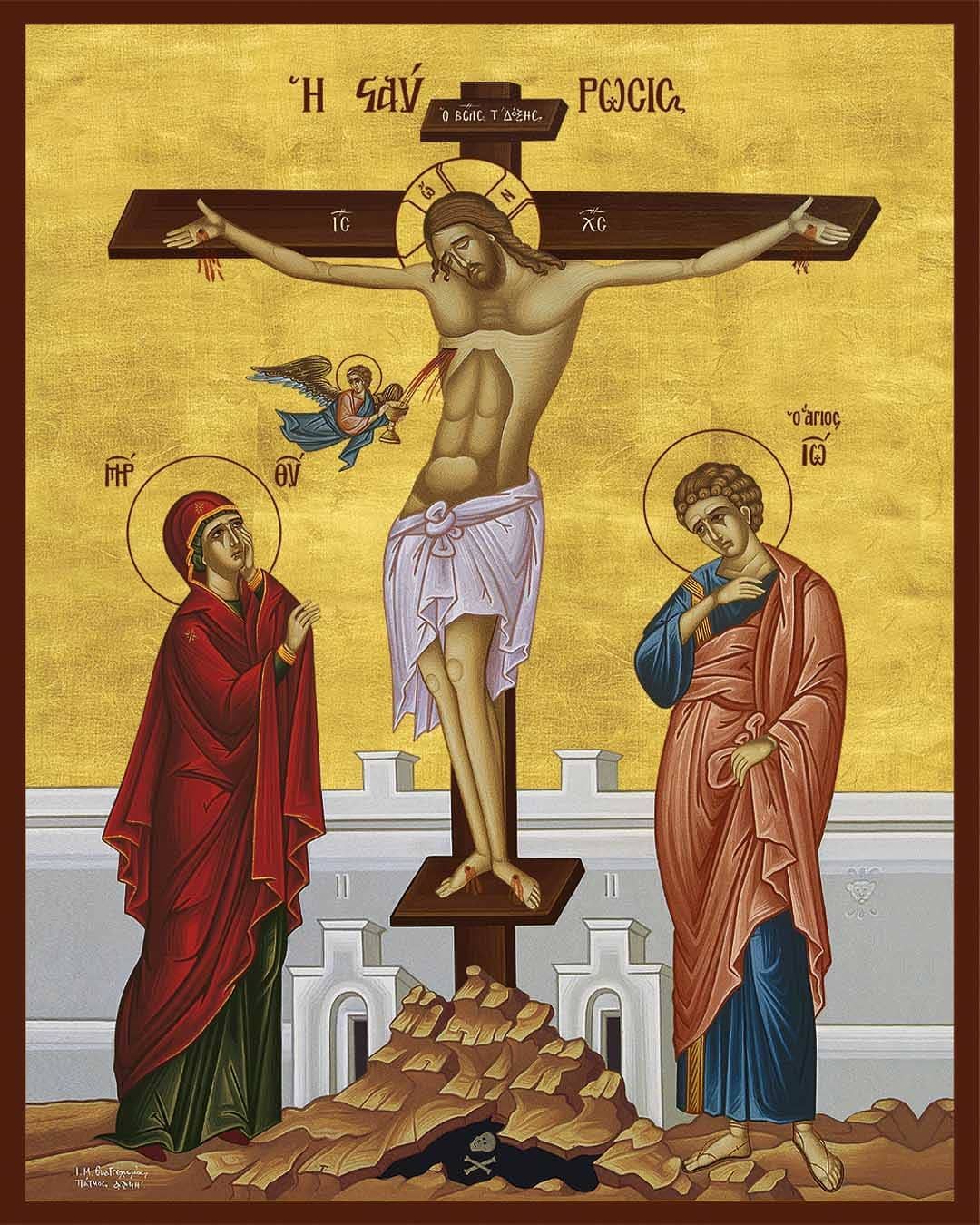
Many in the church today are clinging to God like one reminisces about their childhood. Their childhood was once full of joy and mystery, and yet they have been sucked of the innocence they once possessed but didn’t know was so valuable. God becomes an artifact of the past, an effete deity who must be defended because he cannot defend himself. The confessions become a litmus test to ensure that the congregants believe the correct notions of God. Meanwhile, history continues to unfold, society continues to devolve, and mankind continues to degenerate into a savage animal—not in the sense in which Rousseau used it, but in much more primitive and sinister sense, in which our only concern is in the immediate, for survival. Christians can do nothing efficacious with this God yet vacillate between utter nihilism and boredom, knowing that there is nothing new in our neoliberal society, and heightened expectation and hope, bordering the frenetic and maniacal, that God will soon rip apart history and dismantle the evil structures that existentially threaten Being. Schelling declares, in contradistinction, that God is not a system of beliefs, but a Life, he is the Living God, and subject to suffering and becoming. Schelling built his entire system on Freedom in the most metaphysical sense. God, as Being subjected to time and change, suffers with us. This, of course, has prodigious implications for the Church.
Discover more from Blessed are the Poor in Spirit
Subscribe to get the latest posts sent to your email.
 Blessed are the Poor in Spirit